PUBLICATION PROCESS
The Journal of Adaptive Education utilizes the Open Journal Systems (OJS) platform, an open-source software for managing and publishing scientific journals. OJS is developed and freely distributed by the Public Knowledge Project (PKP) under the GNU General Public Licence.
The process of publishing articles in this journal follows the flow as shown below.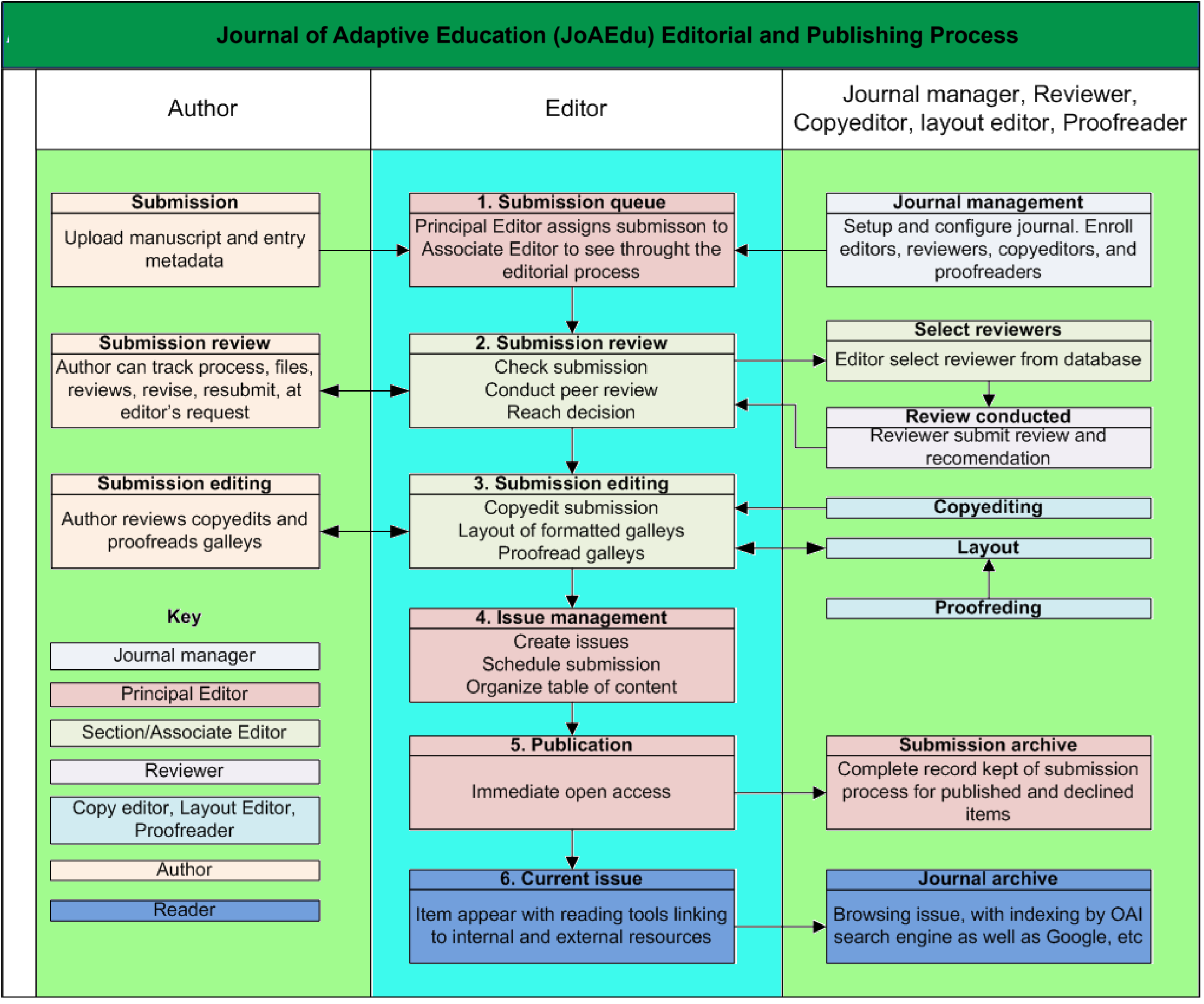
Submission of Paper
The corresponding or submitting author uploads the manuscript and enters the metadata in the Open Journal Systems (OJS) platform. At this stage, the author can also track submission progress, view files, monitor review status, and revise and resubmit the manuscript if requested by the editor.
Editorial Office Assessment
The journal team checks the paper’s composition and formatting against the Journal of Adaptive Education Author Guidelines to ensure it includes all required sections, citations, and stylistic elements. The scientific quality of the paper is not assessed at this stage.
Appraisal by the Principal Editor (Editor-in-Chief)
The Principal Editor evaluates whether the paper fits the scope of Journal of Adaptive Education and shows sufficient originality and scholarly interest. If not, the paper may be rejected without further review.
Assignment to Section/Associate Editor
The Principal Editor assigns the submission to a Section Editor or Associate Editor, who oversees the full editorial and peer-review process for that manuscript.
Invitation to Reviewers
The handling Section Editor selects and invites potential reviewers from the journal’s reviewer database. Journal of Adaptive Education uses a single-blind review process: reviewers know the authors' identities, but the authors do not know who the reviewers are. At least two reviewers with relevant expertise are invited for each manuscript.
Response to Invitations
Invited reviewers consider their expertise, possible conflicts of interest, and availability. They may accept or decline. If they decline, they are encouraged to suggest alternative reviewers.
Review Conducted
Reviewers read the manuscript thoroughly. The first read provides an initial impression; if major flaws are found, the reviewer may recommend rejection. Otherwise, they conduct a detailed, point-by-point evaluation and submit their review with a clear recommendation: accept, revise, or reject. All reviews are submitted confidentially through OJS. Given the single-blind policy, reviewers are asked to provide constructive, unbiased feedback.
Editors Evaluate the Reviews
The Section Editor considers all returned reviews. If the reviewers’ opinions differ significantly, the editor may invite an additional reviewer before making a final decision.
Decision Communicated
The Section Editor communicates the final decision to the author by email, including all relevant reviewer comments and editorial notes. If a revision is requested, the author must address all comments and submit a revised manuscript. Reviewers who opted to continue will receive the revised version for re-evaluation.
Submission Editing (Production Phase)
Once a manuscript is accepted:
- The Copy Editor copyedits the manuscript to improve clarity, grammar, and consistency.
- The Layout Editor formats the manuscript into production-ready galleys.
- The Proofreader checks the final galleys for remaining errors.
- The author reviews the copyedits and proofreads the galleys before final approval.
Issue Management
The journal manager and editorial team schedule the accepted article into a specific issue, create the issue structure, and organize the Table of Contents (TOC).
Publication & Open Access
Journal of Adaptive Education applies an immediate open access policy. Upon publication, all articles are freely available worldwide without subscription or paywall.
Current Issue & Reading Tools
Once published, articles appear in the current issue with integrated reading tools that link to internal and external scholarly resources, improving discoverability and user engagement.
Archive & Indexing
A complete record of the submission process—including all correspondence, reviews, and editorial decisions—is preserved in the submission archive for both published and declined manuscripts. In addition, the journal archive allows browsing by issue, and all content is indexed by OAI-compliant search engines, Google Scholar, and other major academic databases.