Collaboration and Social Interaction in Mathematics Learning in Multicultural Classrooms: A Qualitative Case Study
DOI:
https://doi.org/10.23960/mtk/v14i2.pp177-193Keywords:
collaboration, mathematics learning, multicultural classroom, social interactionAbstract
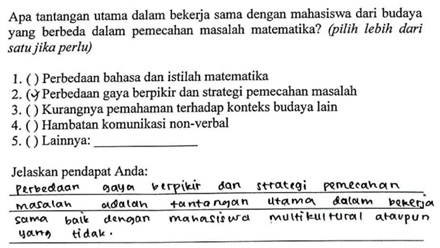
Mathematics learning in multicultural classrooms requires collaborative interaction that accommodates students’ cultural and linguistic diversity. This study aims to explore how cultural diversity shapes collaboration and social interaction in mathematics learning in a multicultural classroom. This study employed a qualitative case study design. The participants were 16 undergraduate mathematics education students at a private university in Metro City, Indonesia. The classroom was categorized as multicultural because the students came from different cultural backgrounds and showed variations in language use, communication styles, ways of expressing opinions, and approaches to group discussion and mathematical problem solving. Data were collected through questionnaires, semi-structured interviews, participatory observation, and documentation. The questionnaire covered three aspects: students’ experiences and perceptions of multicultural classrooms, group dynamics in mathematical problem solving, and collaborative projects in mathematics learning. The data were analyzed through data reduction, categorization, interpretation, and conclusion drawing, with source and technique triangulation used to strengthen the credibility of the findings. The results show that cultural diversity did not directly determine students’ mathematical problem-solving ability, which was more strongly influenced by their understanding of the material. However, cultural diversity affected the communication process, discussion dynamics, and ways students expressed mathematical ideas. Differences in language, thinking styles, and communication patterns became the main challenges in group interaction. Nevertheless, most students were able to collaborate with peers from different cultural backgrounds. These findings indicate that multicultural mathematics classrooms require inclusive interaction strategies, heterogeneous grouping, and clear classroom communication to support effective collaboration and social interaction.
References
Abacioglu, C. S., Epskamp, S., Fischer, A. H., & Volman, M. (2023). Effects of multicultural education on student engagement in low-and high-concentration classrooms: the mediating role of student relationships. Learning Environments Research, 26(3), 951-975. https://doi.org/10.1007/s10984-023-09462-0
Abdulrahim, N. A., & Orosco, M. J. (2020). Culturally responsive mathematics teaching: a research synthesis. The Urban Review, 52(1), 1-25. https://doi.org/10.1007/s11256-019-00509-2
Anggraini, R., & Lubis, I. M. (2022). Students’ perceptions on multicultural classroom: a case study in one private university in medan. International Conference on Sustainable Innovation on Humanities, Education, and Social Sciences (ICOSI-HESS 2022). https://doi.org/10.2991/978-2-494069-65-7_33
Clivaz, S., & Miyakawa, T. (2020). The effects of culture on mathematics lessons: an international comparative study of a collaboratively designed lesson. Educational Studies in Mathematics, 105(1), 53-70. https://doi.org/10.1007/s10649-020-09980-1
Cohen, D. K., Raudenbush, S., & Ball, D. L. (2002). Resources, instruction, and research. In R. Boruch & F. Mosteller (Eds.), Evidence matters: Randomized trials in education research (pp. 80–119). Washington, DC: Brookings Institution Press.
de Oliveira, L. C., & Civil, M. (Eds.). (2020). Teaching mathematics to English language learners: Preparing pre-service and in-service teachers. Palgrave Macmillan. https://doi.org/10.1007/978-3-030-48355-5
Esmonde, I. (2016). Power and Sociocultural Theories of Learning. In Power And Privilege In The Learning Sciences (pp. 24-45). Routledge.
Fatmanissa, N., Siswono, E., Yuli, T., Lukito, A., & Rahaju, E. B. (2022). Collaborative problem solving in mathematics: A systematic literature review. Pedagogy Studies/Pedagogika, 148(4), 45. https://doi.org/10.15823/p.2022.148.3
Graven, M., & Heyd-Metzuyanim, E. (2019). Mathematics identity research: The state of the art and future directions. ZDM–Mathematics Education, 51 (3), 361–377. https://doi.org/10.1007/s11858-019-01050-y
Greer, B., Mukhopadhyay, S., Powell, A. B., & Nelson-Barber, S. (2009). Culturally Responsive Mathematics Education. Routledge New York.
Güven, N. D., & Dede, Y. (2017). Examining social and sociomathematical norms in different classroom microcultures: mathematics teacher education perspective. Educational Sciences: Theory and Practice, 17(1), 265-292. https://doi.org/10.12738/estp.2017.1.0383
Hendri, S., Sa’dijah, C., & Muksar, M. (2025). Integration of multicultural discovery learning and computational thinking in elementary mathematics education: a systematic literature review. Journal of Ecohumanism, 4(2), 1233–1247-1233–1247. https://doi.org/10.62754/joe.v4i2.6223
Hunter, J. (2021). An intersection of mathematics educational values and cultural values: Pāsifika students’ understanding and explanation of their mathematics educational values. ECNU Review of Education, 4(2), 307-326. https://doi.org/10.1177/2096531120931106
Jimenez-Silva, M., Martin, R., Restani, R., Abdelrahim, S., & Albano, T. (2025). Supporting multilingual students’ mathematical discourse through teacher professional development grounded in design-based research: a conceptual framework. Education Sciences, 15(6), 778. https://doi.org/10.3390/educsci15060778
Langer-Osuna, J. M., Gargroetzi, E., Munson, J., & Chavez, R. (2020). Exploring the role of off-task activity on students’ collaborative dynamics. Journal of Educational Psychology, 112(3), 514. https://psycnet.apa.org/doi/10.1037/edu0000464
Langer-Osuna, J. M., & Nasir, N. i. S. (2016). Rehumanizing the “Other” race, culture, and identity in education research. Review of Research in Education, 40(1), 723-743. https://doi.org/10.3102/0091732X16676468
Mazana, M. Y., Montero, C. S., Casmir, R. C., & Oyelere, S. S. (2024). Designing and testing a contextual factors-based teaching and learning model for blended mathematics instruction. Contemporary Mathematics, 3900-3928. https://doi.org/10.37256/cm.5320243176
Moschkovich, J. N. (2015). Academic literacy in mathematics for English learners. The Journal of Mathematical Behavior, 40, 43-62. https://doi.org/10.1016/j.jmathb.2015.01.005
Moschkovich, J. N. (2019). A naturalistic paradigm: An introduction to using ethnographic methods for research in mathematics education. Compendium for early career researchers in mathematics education, 59, 59-79. https://doi.org/10.1007/978-3-030-15636-7_3
Pitaloka, Y. A., & Neolaka, G. A. A. (2023). Exploratory study: how students in multicultural environment display collaboration skills through jigsaw model implementation in primary years. IJECA International Journal of Education & Curriculum Application, 6(2). https://doi.org/10.31764/ijeca.v6i2.16202
Planas, N. (2018). Language as resource: A key notion for understanding the complexity of mathematics learning. Educational Studies in Mathematics, 98(3), 215-229. https://doi.org/10.1007/s10649-018-9810-y
Qin, X. (2024). Collaborative inquiry in action: a case study of lesson study for intercultural education. Asian-Pacific Journal of Second and Foreign Language Education, 9(1), 66. https://doi.org/10.1186/s40862-024-00294-w
Sabir, A., Wang, Y., & Zou, G. (2024). Differentiation strategies in a multicultural classroom: a case study in an elementary school. International Journal of Educatio Elementaria and Psychologia, 1(6), 319-334.
Samaupan, M. B. (2019). Integration of cultural practices in teaching mathematics. The Asian Conference on Education & International Development, Bicol University, Philippines.
Sharma, S. (2023). Promoting statistical thinking in year 12 multilingual classrooms: a collaborative study. Mathematics Education Research Journal, 36, 123-145. https://doi.org/10.1007/s13394-023-00472-y
Sorge, S., Doorman, M., Maass, K., Straser, O., Hesse, A., Jonker, V., & Wijers, M. (2023). Supporting mathematics and science teachers in implementing intercultural learning. ZDM–Mathematics Education, 55(5), 981-993. https://doi.org/10.1007/s11858-023-01478-3
Tielman, K., den Brok, P., Bolhuis, S., & Vallejo, B. (2012). Collaborative learning in multicultural classrooms: a case study of Dutch senior secondary vocational education. Journal of Vocational Education & Training, 64(1), 103-118. https://doi.org/10.1080/13636820.2011.622448
Wachira, P., & Mburu, J. (2019). Culturally responsive mathematics teaching and constructivism: Preparing teachers for diverse classrooms. Multicultural Learning and Teaching, 14(1), 20160023. https://doi.org/10.1515/mlt-2016-0023
Wong, J. M. S. (2023). Embracing team heterogeneity: a case study of the collaborative teaching practice in an international kindergarten in Hong Kong. International Journal of Child Care and Education Policy, 17(1), 17. https://doi.org/10.1186/s40723-023-00120-9
Downloads
Published
How to Cite
Issue
Section
License
Copyright (c) 2026 Rina Agustina, Selvi Loviana

This work is licensed under a Creative Commons Attribution-ShareAlike 4.0 International License.
Jurnal Pendidikan Matematika Universitas Lampung is licensed under a Creative Commons Attribution-ShareAlike 4.0 International License
Authors who publish with Jurnal Pendidikan Matematika Universitas Lampung agree to the following terms:
- The journal allows the author to hold the copyright of the article without restrictions.
- The journal allows the author(s) to retain publishing rights without restrictions
- The legal formal aspect of journal publication accessibility refers to Creative Commons Attribution ShareAlike 4.0 International License (CC BY-SA).
Jurnal Pendidikan Matematika Universitas Lampung is licensed under a Creative Commons Attribution-ShareAlike 4.0 International License.