
About the Journal
Jurnal Pendidikan Matematika Universitas Lampung (JPM Unila) is a scientific communication media containing research articles related to Mathematics Education. JPM Unila has two ISSN's, namely 2338-1183 (Print) and 2715-856X (Online). Starting in 2020, JPM Unila has been actively publishing 4 Numbers for each Volume or Year which are published every March, June, September and December. Based on the Decree of the Director General of Higher Education, Research and Technology of the Ministry of Education, Culture, Research and Technology of the Republic of Indonesia Number 105/E/KPT/2022, JPM Unila has received accreditation at the SINTA 4 ranking starting from Volume 9 Number 4 of 2021 to Volume 14 Number 3 of 2026. All articles published in JPM Unila will have a Digital Object Identifier (DOI) with DOI Prefix: 10.23960/mtk from Crossref.
Current Issue
Vol. 14 No. 2 (2026): Jurnal Pendidikan Matematika Universitas Lampung
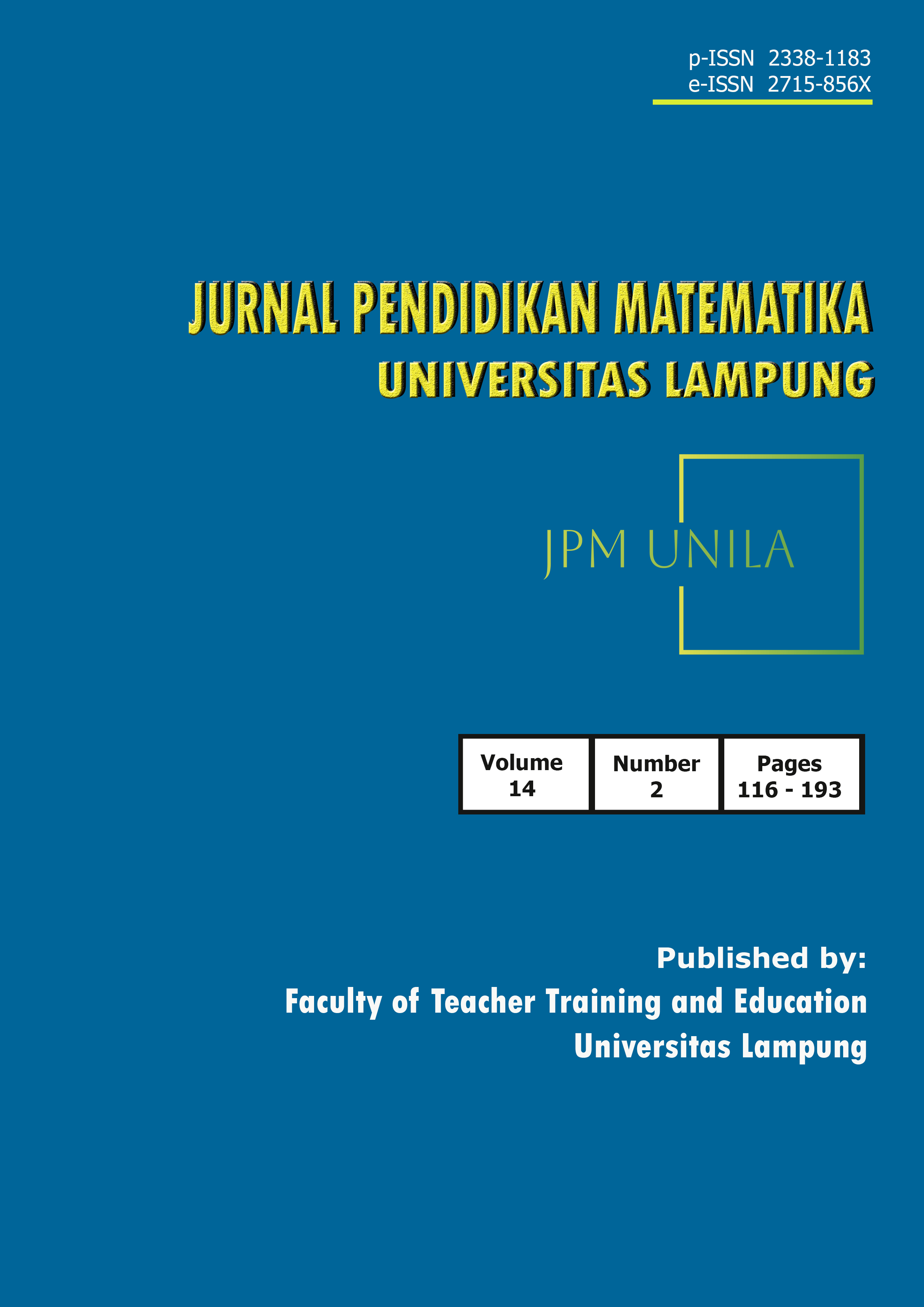
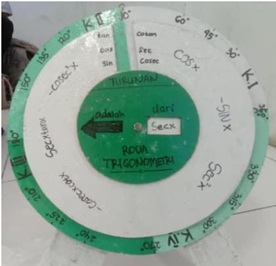
Volume 14, Number 2 (2026) of Jurnal Pendidikan Matematika Universitas Lampung presents six scholarly articles contributed by researchers from Universitas Majalengka, Universitas Islam Malang, Universitas Lampung, Institut Sains dan Teknologi Muhammadiyah Tarakan, Universitas Negeri Gorontalo, Universitas Muhammadiyah Metro, and Universitas Islam Negeri Jurai Siwo Lampung. The articles address a wide range of contemporary issues in mathematics education, including the development of innovative learning media, mathematical problem-solving, critical thinking, mathematical anxiety, self-concept and self-efficacy, technology-assisted learning through Genially, ethnographic perspectives on mathematics for individuals with visual impairments, problem-based learning in statistics, and social interaction in multicultural mathematics classrooms. Collectively, the studies provide empirical and theoretical contributions that enrich mathematics education research while offering practical implications for improving mathematics teaching and learning across diverse educational contexts.
Published:
2026-06-25