Development of a Trigonometric Wheel to Improve Students' Mathematical Problem-Solving Ability
DOI:
https://doi.org/10.23960/mtk/v14i2.pp116-131Keywords:
ADDIE, mathematics learning, mathematical problem-solving ability, media development, trigonometric wheelAbstract
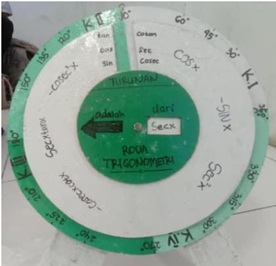
This study aims to develop and evaluate the feasibility of the Trigonometric Wheel manipulative as an interactive learning medium to improve students’ mathematical problem-solving ability in trigonometry topics. This research employed the Research and Development (R&D) method using the ADDIE development model (Analysis, Design, Development, Implementation, and Evaluation), carried out through the Implementation stage. The research subjects consisted of 30 eleventh-grade students at a public senior high school in Majalengka Regency during the 2024/2025 academic year. The instruments used included expert validation sheets, teacher and student response questionnaires, and a mathematical problem-solving ability test based on Polya’s indicators. The results of media expert validation showed an average score of 76.5% (Valid), while material expert validation reached 85.97% (Highly Valid). Teacher and student responses also indicated highly practical categories, with percentages of 90.54% and 88.61%, respectively. As part of the implementation phase, an embedded pre-test and post-test assessment was conducted, revealing an improvement in students' mathematical problem-solving ability with an average N-Gain score of 0.79 (high category). These findings indicate that the Trigonometric Wheel is valid, practical, and shows strong potential as an innovative learning medium that helps students understand trigonometric concepts visually and interactively while enhancing their problem-solving ability.
References
Ahmed, S. Z., Sultan, S., Kousar, M., Basit, H. A., Zaid, R., & Bano, S. (2023). Effectiveness of Teacher’s Centered Approach on Student’s Learning at University Level. Journal of Positive School Psychology, 6(10), 415–428.
Alfitri, P. A. A., Kurniati, N., Prabawanto, S., & Yulianti, K. (2024). An Exploration of High School Students’ Errors in Solving Trigonometry Problems. Jurnal Cendekia: Jurnal Pendidikan Matematika, 08(2005), 714–724. https://doi.org/10.31004/cendekia.v8i1.2109
Angelina, C., Siregar, J., Alfiyyah, S., Kusnadi, A., Jannah, M., & Wardani, S. I. (2021). Pengembangan Media Pembelajaran Roda Berputar untuk Materi Trigonometri. Journal of Instructional Development Research, 2(2), 81–94.
Cahyono, B., Karoso, S., Sugito, & Baso, R. S. (2024). Implementasi Media Manipulatif Untuk Pemahaman Siswa dalam Pembelajaran Matematika. Indonesian Journal of Learning and Instructional Innovation, 2(01), 1–6. https://doi.org/10.20961/ijolii.v2i01.1303
Chacón-Castro, M., Buele, J., López-Rueda, A. D., & Jadán-Guerrero, J. (2023). Pólya’s Methodology for Strengthening Problem-Solving Skills in Differential Equations: A Case Study in Colombia. Computers, 12(11), 239. https://doi.org/10.3390/computers12110239
Deswita, H. (2020). Respon Siswa Terhadap Alat Peraga Laga Sumatri (Ular Tangga Sudut Istimewa-Trigonometri). Pythagoras: Jurnal Program Studi Pendidikan Matematika, 9(1), 28–40.
Dewi, N. P., & Ananda, F. F. (2023). Pengembangan Alat Peraga “TRIGOPOLI”: Trigonometri Putar Roda dan Tali. Polinomial : Jurnal Pendidikan Matematika, 2(2), 46–54. https://doi.org/10.56916/jp.v2i2.608
Do, H., Do, B. N., & Nguyen, M. H. (2023). How Do Constructivism Learning Environments Generate Better Motivation and Learning Strategies ? The Design Science Approach. Heliyon, 9(12), e22862.
https://doi.org/10.1016/j.heliyon.2023.e22862
Fadiyah, H., Wahyuni, S., Rahmadiani, O., & Nurulaeni, F. (2024). Analysis of the Use of Manipulative Media to Understand Mathematical Concepts Elementary School Students. Proceedings of the International Conference on Education, Humanities, and Social Science. https://doi.org/10.2991/978-2-38476-249-1
Hidayat, W., Rohaeti, E. E., Hamidah, I., & Putri, R. I. I. (2023). How Can Android-Based Trigonometry Learning Improve the Math Learning Process ?. Frontier in Education, 7, 1101161. https://doi.org/10.3389/feduc.2022.1101161
Kaka, N. L., Abidullah, Sirajuddin, Mahsup, & Mandailina, V. (2022). Pengembangan Alat Peraga Roda Pintar Sebagai Media Pembelajaran Matematika Materi Trigonometri. Seminar Nasional Paegoria, 2, 251–259. http://journal.ummat.ac.id/index.php/fkip/article/view/10353
Kholikin, K., Mulyani, S., & Sudibyo, H. (2024). Pengembangan Media Pembelajaran Berbantukan Media Animaker untuk Meningkatkan Hasil Belajar Siswa Kelas VI pada Materi Bangun Ruang. Journal of Education Research, 5(3), 3290–3300. https://doi.org/10.37985/jer.v5i3.1454
Lestari, S. T., Safirah, A., Alfadillah, W., & Sari, I. K. (2023). Pengembangan Alat Peraga Kincir Trigonometri untuk Pembelajaran Matematika Tingkat SMA. Pendidikan Matematika, 3(80), 263–274.
https://jim.unindra.ac.id/index.php/himpunan/article/view/10560
Mayer, R. E., & Fiorella, L. (Eds.). (2021). The Cambridge handbook of multimedia learning (3rd ed.). Cambridge University Press. https://doi.org/10.1017/9781108894333
Nabila, H. I., Fitriani, N., & Setiawan, W. (2022). Pengembangan media pembelajaran video animasi menggunakan animaker pada materi statistika. Jurnal Ilmiah Profesi Guru (JIPG), 3(2), 162–171.
https://doi.org/10.30738/jipg.vol3.no2.a12704
Nurmeidina, R., & Rafidiyah, D. (2019). Analysis of students’ difficulties in solving trigonometry problems. Proceedings of the 4th Progressive and Fun Education International Conference (Profunedu 2019). European Alliance for Innovation. https://doi.org/10.4108/eai.7-8-2019.2288422
Setiawan, Y. E. (2023). Classification of errors in determining trigonometry function values at standard positions. JRAMathEdu (Journal of Research and Advances in Mathematics Education), 8(2), 123–139.
https://doi.org/10.23917/jramathedu.v8i2.1625
Shakeel, S.I., Al Mamun, M. & Haolader, M. Instructional design with ADDIE and rapid prototyping for blended learning: validation and its acceptance in the context of TVET Bangladesh. Educ Inf Technol 28, 7601–7630 (2023). https://doi.org/10.1007/s10639-022-11471-0.
Siswanto, E. (2024). Kemampuan pemecahan masalah pada pembelajaran matematika : systematic literature review. JRPMS (Jurnal Riset Pembelajaran Matematika Sekolah), 8(1), 45–59. https://doi.org/10.21009/jrpms.081.06
Stacey, K. (2022). Looking back on Polya’s teaching of problem solving (Vol. 2). Teaching Mathematics and Computer Science, 20 (2), 207-217. https://doi.org/10.5485/TMCS.2022.0533
Syifa, A. Q., & Kurniawati, I. (2025). Student error in grade x on the concept of trigonometry using a hermeneutic phenomenological study. Jurnal Pendidikan Matematika, 16(2), 182–196.
https://doi.org/https://doi.org/10.36709/jpm.v16i2.333
Wahab, A., Junaedi, J., & Azhar, M. (2021). Efektivitas pembelajaran statistika pendidikan menggunakan uji peningkatan n-gain di pgmi. Jurnal Basicedu, 5(2), 1039–1045. https://doi.org/10.31004/basicedu.v5i2.845
Yapatang, L., & Polyiem, T. (2022). Development of the mathematical problem-solving ability using applied cooperative learning and polya ’ s problem-solving process for grade 9 students. Journal of Education and Learning, 11(3), 40–46. https://doi.org/10.5539/jel.v11n3p40
Downloads
Published
How to Cite
Issue
Section
License
Copyright (c) 2026 Jurnal Pendidikan Matematika Universitas Lampung

This work is licensed under a Creative Commons Attribution-ShareAlike 4.0 International License.
Jurnal Pendidikan Matematika Universitas Lampung is licensed under a Creative Commons Attribution-ShareAlike 4.0 International License
Authors who publish with Jurnal Pendidikan Matematika Universitas Lampung agree to the following terms:
- The journal allows the author to hold the copyright of the article without restrictions.
- The journal allows the author(s) to retain publishing rights without restrictions
- The legal formal aspect of journal publication accessibility refers to Creative Commons Attribution ShareAlike 4.0 International License (CC BY-SA).
Jurnal Pendidikan Matematika Universitas Lampung is licensed under a Creative Commons Attribution-ShareAlike 4.0 International License.