Publication Process
Journal of Advances in Physics Education (JAPE)
Journal of Advances in Physics Education is a leading scientific publication committed to advancing academic thinking in the field of physics. This journal is identified with electronic ISSN number 3109-0702. The journal is published two times a year, in May, and November. Each edition contains about 15 and a minimum 5, providing an opportunity for contributors and readers to continue to get the latest information in the field of physics.
Publication Process
The Journal of Advances in Physics Education utilizes the Open Journal Systems (OJS) platform, an open-source software for managing and publishing scientific journals. OJS is developed and freely distributed by the Public Knowledge Project (PKP) under the GNU General Public Licence.
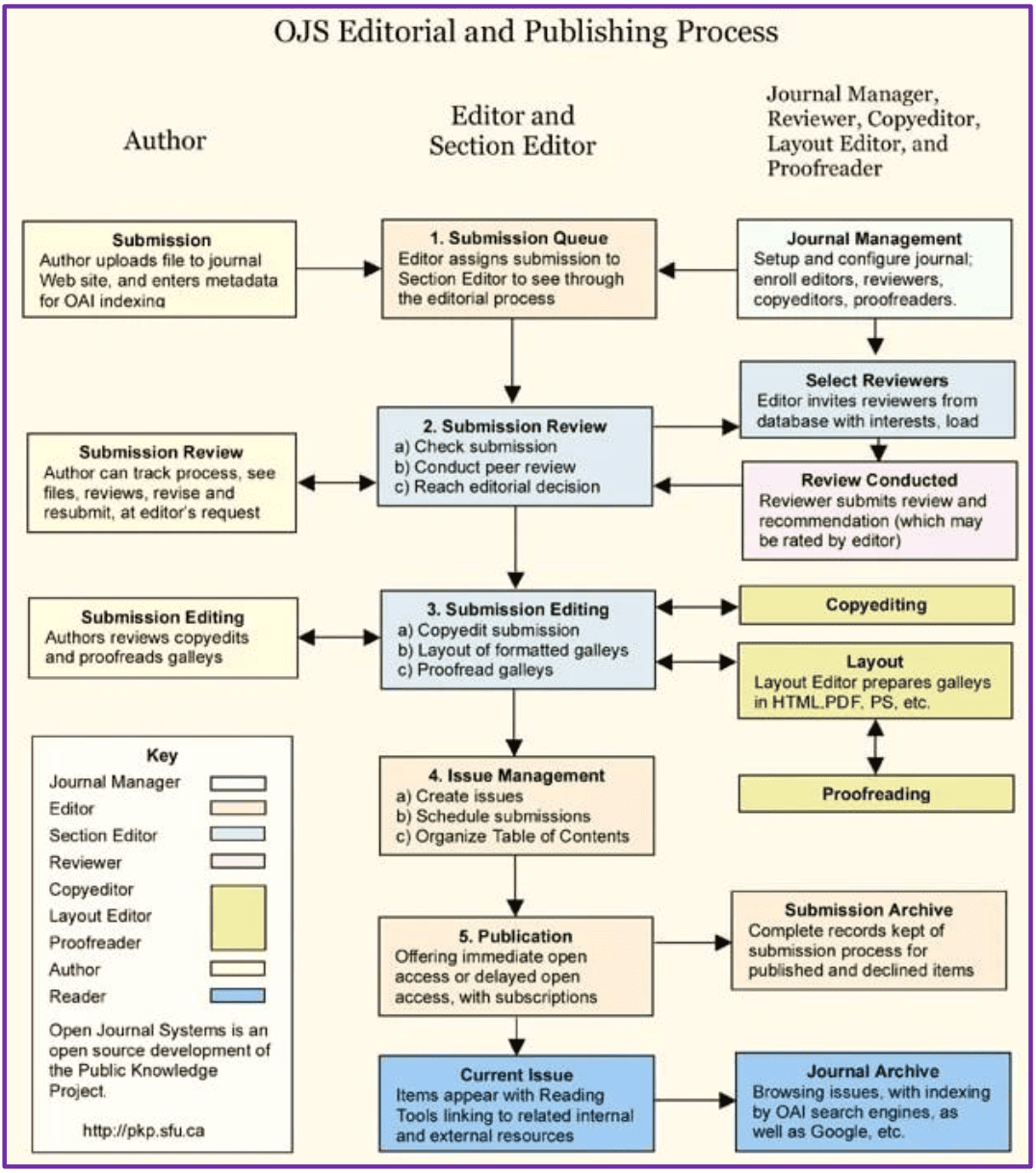
The process of publishing articles in this journal follows the flow as shown below:
1. Submission of PaperThe corresponding or submitting author initiates the process by uploading the manuscript and all associated supplementary files through the Journal of Advances in Physics Education Open Journal Systems (OJS) platform. At this stage, the author is required to verify that the submission conforms to the journal's scope and that all co-authors have approved the submission.
|
2. Editorial Office AssessmentUpon receipt, the Journal of Advances in Physics Education Editorial Office conducts an initial technical check. This assessment verifies that the manuscript adheres to the journal’s formatting and structural requirements as outlined in the Author Guidelines—including proper section headings, citation style, figure and table placement, and completeness of metadata. It is important to note that this step does not involve an evaluation of the scientific content or the quality of the research. |
|
3. Appraisal by the Editor-in-Chief (EiC)The manuscript is then forwarded to the Editor-in-Chief of Journal of Advances in Physics Education for a preliminary scientific appraisal. The EiC evaluates whether the work falls within the journal’s core focus on physics education research, pedagogy, and curriculum development, and assesses its potential for originality, significance, and interest to the readership. Manuscripts that are deemed out of scope or insufficiently novel may be rejected at this stage without further peer review, often with a brief editorial explanation. |
4. EiC Assigns a Section Editor (SE)Manuscripts that pass the initial editorial screening are assigned to a Section Editor who possesses relevant expertise in the specific area of physics education addressed by the paper. The Section Editor assumes responsibility for managing the subsequent peer-review process, including reviewer selection and final recommendation.
|
|
5. Invitation to ReviewersThe assigned Section Editor invites a pool of potential reviewers who are recognized experts in the relevant subfield of physics education. The journal operates a single-blind peer-review policy, meaning that reviewers are aware of the authors' identities, but authors are not informed of the reviewers' identities. A minimum of two independent reviewers are sought, and additional invitations may be issued until the required number of acceptances is achieved. |
6. Response to InvitationsInvited reviewers are asked to consider their availability, potential conflicts of interest, and alignment of their expertise with the manuscript's subject matter. Reviewers may either accept or decline the invitation. In the case of a decline, reviewers are encouraged to suggest alternative qualified experts to facilitate the process.
|
|
7. Review is ConductedEach reviewer undertakes a thorough and structured evaluation of the manuscript. The initial reading serves to form a general impression; if major fundamental flaws are apparent, the reviewer may recommend rejection without further detailed commentary. Otherwise, the reviewer performs multiple close readings, annotating the text and compiling a comprehensive, point-by-point critique. The final review is submitted through the OJS system, accompanied by a clear recommendation: Accept, Minor Revision, Major Revision, or Reject. Journal of Advances in Physics Education strives to complete the initial review cycle within approximately one month of submission. |
8. Editors Evaluate the ReviewsOnce all required reviews are received, the handling Section Editor synthesizes the comments and recommendations. Should the reviews present conflicting or divergent opinions, the editor may opt to consult an additional, independent reviewer to reach a balanced and well-informed decision. The Section Editor then formulates a final editorial recommendation, which is submitted to the Editor-in-Chief for final approval.
|
|
9. Decision is CommunicatedThe final editorial decision—along with the consolidated reviewer comments and any additional editorial notes—is communicated to the corresponding author via email. Authors are required to respond to each reviewer comment comprehensively and resubmit the revised manuscript, accompanied by a detailed point-by-point response letter, unless the decision is an outright rejection. Reviewers who have opted to continue participation will typically be invited to assess the revised version.
|
10. Last StepsFor manuscripts that are accepted, the paper enters the production phase, where it undergoes copyediting, typesetting, and proofreading prior to online publication. The corresponding author will receive a notification and further instructions regarding proof corrections and publication fees, if applicable. For manuscripts that are rejected, the editorial team strives to provide constructive feedback—including reviewer comments and editorial insights—aimed at helping the authors improve their work for potential submission to other venues or for resubmission to Journal of Advances in Physics Education in the future. |
Editorial and Publishing Process of the Journal of Advances in Physics Education (JAPE)