The Effect of Using Genially on Eighth-Grade Students’ Understanding of Mathematical Concepts in the Pythagorean Theorem
DOI:
https://doi.org/10.23960/mtk/v14i2.pp157-167Keywords:
genially media, pythagorean theorem, understanding mathematical conceptsAbstract
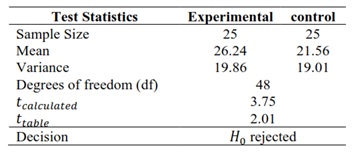
This study aims to determine the effect of using Genially media on students' understanding of mathematical concepts in Pythagorean theorem material for eighth grade. This research is a quantitative study with a quasi-experimental method using a pretest-posttest control group design. The population was all eighth-grade students of SMP Negeri 2 Limboto. The sample was selected using random sampling technique, consisting of an experimental class of 25 students who learned using Genially media and a control class of 25 students who learned using PowerPoint media. The instrument used was an essay test consisting of 10 questions that had been validated and declared reliable with Cronbach’s Alpha coefficient of 0.8751. The results showed that the average posttest score of the experimental class was 26.24, higher than the control class which was 21.56. Hypothesis testing using independent samples t-test obtained , while at significance level so was rejected and was accepted. The effect size calculation using Cohen's d yielded a value of 1.06 which falls into the strong effect category. The conclusion of this study is that there is a strong effect of using Genially media on students' understanding of mathematical concepts in Pythagorean theorem material.
References
Aleupah, M. K., Gella, N. J. M., & Bien, Y. I. (2023). Ability to understand mathematical concepts of students through mind mapping method. International Journal of Humanities Education and Social Sciences (IJHESS), 2(4), 1186–1192. https://doi.org/10.55227/ijhess.v2i4.353
Bito, N., & Masaong, A. K. (2023). Peran media pembelajaran matematika sebagai teknologi dan solusi dalam pendidikan di era digitalisasi dan disruption. Jambura Journal of Mathematics Education, 4(1), 88–97. https://doi.org/10.34312/jmathedu.v4i1.17376
Halim, A., & Hadi, M. S. (2023). Analisis efektivitas penggunaan media digital dalam meningkatkan pemahaman konsep matematika peserta didik kelas VII SMP Negeri 275 Jakarta. Innovative: Journal of Social Science Research, 3(3), 8333–8341.
Hanifah, U., Ekowati, W. D., & Aini, D. F. N. (2024). A systematic literature review of mathematics learning media and its contributions. Research and Development in Education (RaDEn), 4(1), 304–319. https://doi.org/10.22219/raden.v4i1.32145
Ibrahim, F., Ismail, S., & Ismail, Y. (2024). Research in the mathematical and natural sciences deskripsi pemahaman konsep kubus dan balok melalui pembelajaran daring. Research in the Mathematical and Natural Sciences, 3(2), 60–66. https://doi.org/10.55657/rmns.v3i2.167
Indrayati, S. A. (2020). Efektifitas layanan bimbingan dan konseling islam dalam meningkatkan kualitas pribadi siswa di SMA negeri 7 yogyakarta. G-COUNS: Jurnal Bimbingan dan Konseling, 5(1), 23–30.
https://doi.org/10.31316/g.couns.v5i1.1182
Irwanto, A., Jufri, L. H., & Yunita, A. (2023). Analisis pemahaman konsep matematis pada materi persamaan garis lurus siswa kelas VIII SMP negeri 23 padang. Jurnal Pembelajaran dan Matematika Sigma (JPMS), 9(1), 74–84. https://doi.org/10.36987/jpms.v9i1.4343
Kemdikbudristek. (2022). Capaian Pembelajaran Mata Pelajaran Matematika dalam Kurikulum Merdeka.
Kodai, M., Badu, S. Q., & Yahya, L. (2024). Kemampuan pemahaman konsep matematis siswa dirinjau dari tipe kepribadian florence littauer. Lebesgue: Jurnal Ilmiah Pendidikan Matematika, Matematika dan Statistika, 5(2), 736–751. https://doi.org/10.46306/lb.v5i2
Mahadi, A., Machmud, T., & Pauweni, K. A. Y. (2023). The effect of cooperative model type STAD assisted by interactive learning media on students ’ understanding of mathematical concepts. Union: Jurnal Ilmiah Pendidikan Matematika, 11(1), 51–57. https://doi.org/10.30738/union.v11i1.13834
Mayer, E. R. (2002). Multimedia Learning. In Psikology of learning and Motivation (Vol. 41). Academic Press.
Muhaimin, L. H., & Juandi, D. (2023). The role of learning media in learning mathematics: a systematic literature review. Journal of Mathematics and Mathematics Education, 13(01), 85–107.
https://doi.org/10.20961/jmme.v13i1.74425
Oktovianus, M. (2025). Pengaruh penggunaan media pembelajaran berbasis genially terhadap hasil belajar matematika peserta didik kelas II UPTD SD inpres oeba 4 kota kupang. Pendas: Jurnal Ilmiah Pendidikan Dasar, 10(3), 259–266. https://doi.org/10.23969/jp.v10i03.30942
Pauweni, K. A. Y., Usman, K., Abdullah, A. W., & Rusydiy. (2019). Deskripsi pemahaman konsep matematika pada materi bangun ruang sisi lengkung. EULER: Jurnal Ilmiah Matematika, Sains dan Teknologi, 7(2), 37–44. https://doi.org/10.34312/euler.v7i2.10336
Setiawan, N., & Nuryadi. (2024). Analisis pemahaman konsep matematis dalam menyelesaikan soal pada materi teorema pythagoras smp kelas VII. Pedagogi: Jurnal Ilmiah Pendidikan, 10(2), 178–185.
https://doi.org/10.47662/pedagogi.v10i2.777
Sitorus, S. F., & Karo-Karo, S. I. R. (2025). The effect of genially-based interactive media on students’ understanding of mathematical concepts. Journal of General Education and Humanities, 4(4), 1853–1865.
https://doi.org/10.58421/gehu.v4i4.757
Skemp, R. R. (1978). Relational Understanding and Instrumental Understanding. The Arithmetic Teacher, 26(3), 9–15.
Sudjana. (2005). Metode Statistika. Bandung: PT.Tarsito Bandung.
Verina, I., & Darhim. (2023). Kemampuan pemahaman konsep matematis siswa SMP kelas VIII pada topik persegi panjang. AKSIOMA: Jurnal Program Studi Pendidikan Matematika, 12(2), 2063–2076.
https://doi.org/10.24127/ajpm.v12i2.7581
Zamzami, A. N., & Raharjo. (2024). Penggunaan platform genially dan pengaruhnya terhadap hasil belajar mata pelajaran PAI di SMK negeri 2 semarang. Jurnal Budi Pekerti Agama Islam, 2(3), 31–42. https://doi.org/10.61132/jbpai.v2i2.294
Downloads
Published
How to Cite
Issue
Section
License
Copyright (c) 2026 Zulfa Dwi Yanti Tangio Tangio, Sumarno Ismail, Auli Irfah

This work is licensed under a Creative Commons Attribution-ShareAlike 4.0 International License.
Jurnal Pendidikan Matematika Universitas Lampung is licensed under a Creative Commons Attribution-ShareAlike 4.0 International License
Authors who publish with Jurnal Pendidikan Matematika Universitas Lampung agree to the following terms:
- The journal allows the author to hold the copyright of the article without restrictions.
- The journal allows the author(s) to retain publishing rights without restrictions
- The legal formal aspect of journal publication accessibility refers to Creative Commons Attribution ShareAlike 4.0 International License (CC BY-SA).
Jurnal Pendidikan Matematika Universitas Lampung is licensed under a Creative Commons Attribution-ShareAlike 4.0 International License.